No more teaser photos and speculations as Mini came out today with the full press release of the 2007 Cooper & Cooper S versions. The two new models will make their world debut at the Paris Motor Show in September with sales commencing before the end of the year.
2007 MINI IN DETAIL
Exterior -Unmistakable features of MINI design: Every body panel has been re-designed, but MINI's successful form has been retained. The MINI design team brief was continuity in concept, whilst modernising traditional design details and engineering features. The second generation new MINI remains immediately recognisable visually and dynamically.
The typical MINI characteristics of short body overhangs front and rear, the famous wheel-at-each-corner stance and the high shoulder line rising towards the rear have all been retained, as well as the hexagonal radiator grille and the large, round headlights.
 Subtle changes: The new MINI has grown slightly in size from the first generation in order to fulfil future safety requirements. The new MINI Cooper is 60mm longer than its predecessor and the new MINI Cooper S, 61mm longer. But to maintain the car's unmistakable proportions, the designers matched the increase in size at the front by giving the car more rounded contours at the rear.
The round, clear-glass headlights are now fixed to the body and have been turned slightly to the outside to maintain the geometry of the car from the front. The indicators, formerly isolated in the front valance, are now housed within the main headlight units.
The radiator grille is now made up of a closed, self-contained element without the former dividing line made by the upper edge of the bumper. This design is reminiscent of the air intake scoop on the classic Mini.
The MINI Cooper S has a "stronger" front end due to the bonnet curving up approximately 20mm more to provide extra space for the turbocharged engine underneath and to meet pedestrian impact regulations.
Rising gently to the rear, the shoulder line is now 18mm higher than on the former model and visually accentuates the powerful stance of the car's body. The rear lights are now slightly larger and feature separate external surrounds.
On both models, vertical air flow edges on the C-pillars and individual spoilers at the rear end of the roof enhance the level of aerodynamics to an even higher standard than before. The MINI Cooper now has a drag coefficient of 0.33. (0.35 on the previous model).
Customisation of the new MINI starts with a wide range of paintwork colours. 12 body colours will be available, seven of which are brand new.


Interior re-interpreted: The changes in the interior design of the new MINI are as comprehensive, but more immediately visible, than on the exterior. The design of the instrument controls and feel of the surfaces inside the car offer an air of premium quality.
Still the most striking feature inside is the Centre Speedo. It now comprises not only the analogue speedometer, but also all entertainment and, as an option, navigation functions.
The centre console below the Speedo is slimmer to create more space in the footwells for driver and front passenger. The door lock blipper and ignition key is now a round signal sensor. When inserted into a slot beside the steering wheel it allows the driver to press a start/stop button to switch the engine on and off.
New ambient illumination included in the optional lights package is unique in the automotive industry. The colour of the interior lights in the roof lining, the door storage compartments and grab handle recesses may be changed at any time in five stages from warm orange to sporting blue, depending on the occupants personal preference. This is controlled from a new panel of toggle switches in the roof lining. The toggle switches in the dash that operate the electric windows, seat heating and central locking were a real hit with current MINI owners and have been made larger on the new MINI.
A Colour Line option allows individual design of the MINI cockpit. Colour highlights in the lower sections of the dashboard flow on into the door linings, where they are combined with the materials on the trim surfaces. Colour Line is available in five colour shades, with the trim surfaces coming in four exclusive variants over and above the versions already standard on the MINI Cooper and MINI Cooper S: glossy black piano paint, dark brown grained oak, brushed aluminium, and an extra-fine gloss surface.
A set of 16 chrome-plated trim rings for the air vents, cupholders and instruments gives the interior an even more sophisticated look. In the rear, passengers are offered more comfort with recessed knee cut-outs in the front seats lined with material rather than the traditional plastics.

 Mini Cooper - Fully variable valve management instead of a throttle butterfly: The 1.6-litre naturally-aspirated power unit in the MINI Cooper develops maximum output of 120hp at 6,000rpm. Engine torque reaches 140Nm at just 2,000rpm, peaking at 160Nm once the engine reaches 4,250rpm. The MINI Cooper accelerates from 0-62mph (100km/h) in 9.1 seconds and reaches a top speed of 126mph (203 km/h).
This ultra-modern four-cylinder features fully variable valve control based on the BMW Group's unique VALVETRONIC system. This innovative valve management system adjusts intake valve lift and opening times within fractions of a second to meet the power and performance requirements of the driver. The big advantage is that it replaces the conventional throttle butterfly on "normal" engines to translate any movement of the throttle pedal directly into engine speed instantly.
In addition to variable control of valve lift on the intake, valve timing is also controlled on the outlet stroke. This enhances the torque curve to deliver not only high torque at low engine speeds, but also high power at high speeds.
Together these two technologies reduce fuel consumption, depending on the route the driver is covering, by up to 20 per cent. Fuel consumption in the EU test cycle is down by approximately 12.5 per cent. The CO2 emissions on the MINI Cooper are now 139g/km and 164g/km on the MINI Cooper S -a reduction of 43g/km.
MINI Cooper S: twin-scroll turbocharger and direct fuel injection: Displacing 1.6-litres, the four-cylinder turbocharged power unit of the MINI Cooper S now develops an impressive 175hp, up 5hp on the outgoing supercharged engine. Maximum engine power comes at 5,500rpm, with peak torque of 240Nm being maintained consistently between 1,600 and 5,000rpm. When accelerating hard, torque rises to an even higher level of 260Nm by briefly increasing charge pressure through a system named "overboost". It covers the 0-62mph (100 km/h) sprint in 7.1 seconds and achieves a top speed of 140mph (225 km/h).
The MINI Cooper S engine is a Direct Injection petrol power unit. Intake air is pre-compressed by a twin-scroll turbocharger complete with intercooler. Exhaust gases meanwhile are split and forced through the exhaust ducts of two cylinders each, separated from one another in the exhaust gas manifold and the turbocharger. Response time when accelerating is virtually instantaneous.


The high performance of the MINI Cooper S is also enhanced by advanced valve management -four valves per cylinder being operated by two overhead camshafts. The camshaft on the intake side comes with infinitely variable valve timing to manage both engine output and torque while minimising fuel consumption and emissions. The exhaust valves are sodium-filled in order to off-set the higher temperature loads typical of a turbocharged engine.
Innovative technologies around the engine: The Hams Hall-constructed engines featured in the new MINI boast a wide range of innovative technologies. The two-piece bedplate structure of the crankcase, for example, is sophisticated technology derived from motor sport. The cylinder block and bearing housing are made of cast aluminium alloy, while the camshafts on both engines are composite structures, not the usual castings, in order to reduce weight.
The on-demand water pump in the coolant circuit helps to reduce fuel consumption since it is only activated when the engine has reached its regular operating temperature. This helps to save fuel in the warm-up phase and the catalyst is able to reach the temperature required for optimum operation earlier.
Manual Gearshift and Automatic Transmission: Both the new MINI Cooper and MINI Cooper S come as standard with a six-speed manual gearbox. As an option, a six-speed automatic transmission will become available for both models. Paddles on the steering wheel allow the driver to change gear manually without removing his hands from the wheel.

Chassis and Sports Suspension: As with the first generation, spring and damper settings tune the chassis and suspension set-up of the new MINI Cooper S to be firmer and more dynamic than the MINI Cooper. As an option both models are available with an identical Sports Suspension set-up, comprising harder springs, dampers and anti-roll bars.
Front-wheel drive, a low centre of gravity, a long wheelbase, wide track, short body overhangs, a stiff bodyshell and the firm suspension all interact to determine MINI's unique go-kart feeling.
The front axle is based on the MacPherson spring strut principle and features an anti-roll bar to reduce body sway to an absolute minimum. The central-arm rear axle is new to MINI and unique in this segment. Its longitudinal track control arms are made of aluminium that reduces weight by 6 kilos over the former model.
Benefiting from the sophisticated kinematics of the new suspension, the wheels offer improved grip over even more extreme cambers. The rear axle is equipped with an anti-roll bar on both model variants that makes a decisive contribution to the car's famed agility, poise and safe handling.
New electromechanical power-assisted steering: The new EPAS (Electric Power-Assisted Steering) makes a significant contribution to the pin-point behaviour of the new MINI. Speed-related power assistance guarantees low steering forces when parking and, at the same time, precise responses at high speeds on the motorway.
The electric system offers the driver a choice of two different steering control maps. The standard set-up ensures a well-balanced steering response in all speed ranges. The second map is activated when the Sport button is pressed and the power steering becomes even more direct. The electronic map for the accelerator is also modified by the Sport button to give a more instant response.
Run-flats as standard on MINI Cooper S: The MINI Cooper comes as standard with 15-inch light-alloy rims and 175/65 R 15 tyres. Run-flat tyres are standard on the MINI Cooper S that has 16-inch light-alloy rims running on 195/65 R 16 tyres. In the event of a puncture, Run-flat tyres allow drivers to continue their journey for 90 miles at speeds of up to 50mph. Run-flats also provide stability in the event of a blow-out or sudden deflation. Seventeen-inch rims running on 205/45R Run-flat 17 tyres are available as an option on both models.
Safety at all times: Six airbags are standard consisting of front, side and curtain head airbags for the driver and front passenger. The extra-large curtain airbags (integrated in the roof lining) offer optimum protection from head injuries for the rear passengers.
Active safety is ensured in critical situations by ABS anti-lock brakes, EBD Electronic Brake Force Distribution and CBC Cornering Brake Control as standard on both models. ASC+T Automatic Stability Control + Traction is standard on the MINI Cooper S with on-off control by the driver, and as an option DSC Dynamic Stability Control.


Included within the option of DSC is Hill Assist. This feature holds a manual MINI on the brake when setting off on a gradient to prevent it from rolling back.
Passive safety was another primary aim of the new MINI's designers and the new car offers all the prerequisites for optimum results in crash tests.
The transverse engine of the new MINI combined with the extra-large deformation zones at the front absorbs most of the impact forces in the event of a collision. Highly stable crossbars and reinforced door structures also help to keep impact energy away from the passenger cell. The same effect is provided by the front axle absorbing energy and passing impact forces on through the floor of the car.
The electric fuel pump is switched off automatically in the case of a severe accident to prevent any chance of a fuel fire. At the same time the central locking is opened and both the interior lights and hazard warning flashers are immediately activated to attract attention.
Technorati: Mini+Cooper, Cooper+S, 2007, specifications, press+release, Paris+Motor+Show, auto+news, automobile, autos, vehicles, automotive, cars


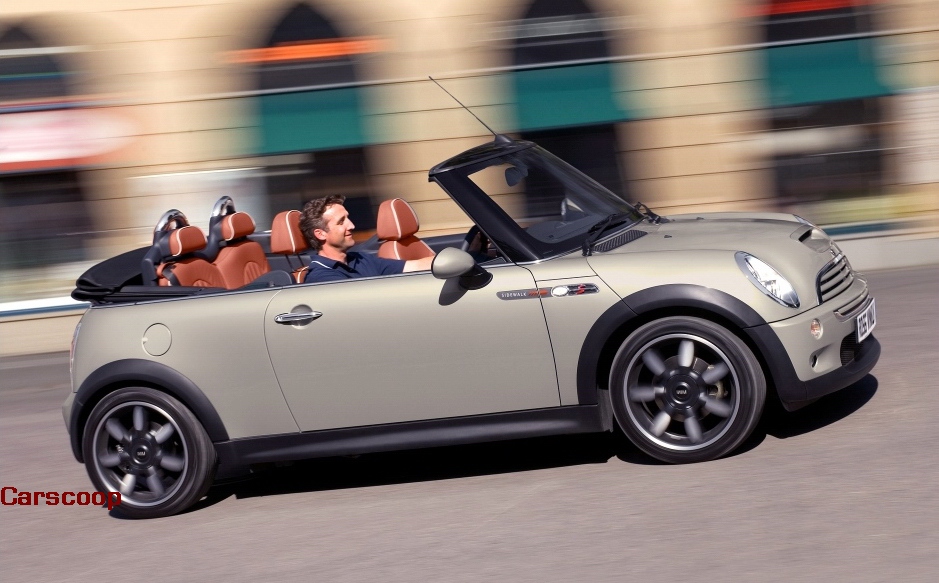 Jeez, we got all red and excited when we first saw the press release, but I believe you’ll forgive us as it’s not as if one can easily distinguish the MINI I & II from each other. Anyway, the Sidewalk is a new addition to the MINI Convertible range which will make its premiere at the 2007 North American International Auto Show (NAIAS).
 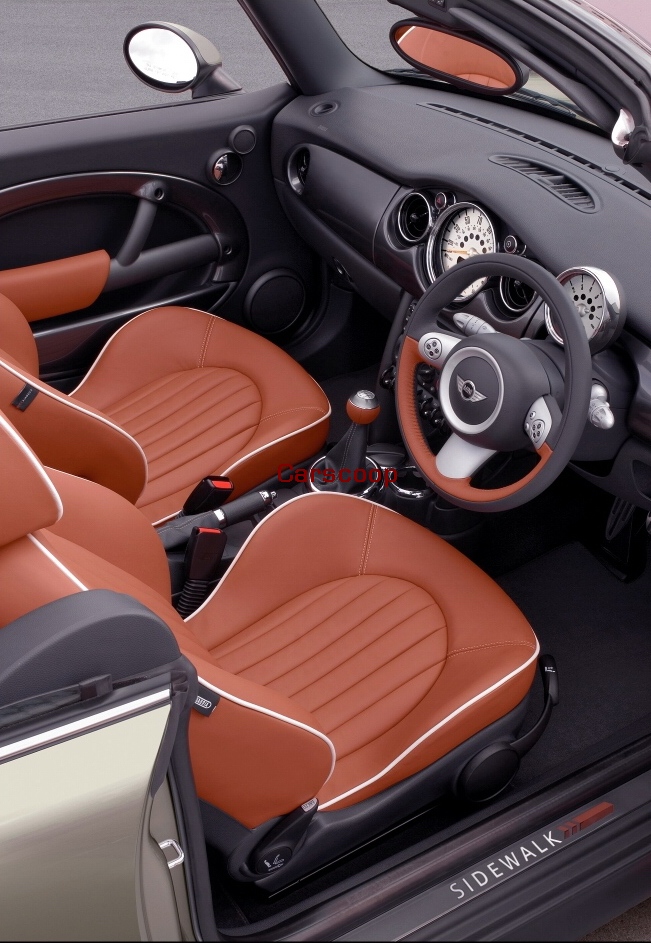 According to MINI, should a customer wish to specify these options on any other MINI Convertible, the cost of the extra kit would be approximately 25 per cent higher than if purchased as part of a standard package on the Sidewalk edition. Sales start in April 2007.